
Every IBC has its buzzwords. What’s more interesting is seeing which ideas actually make people stop and start a conversation.
At this year’s IBC, one conversation often led to another: Multiview to engagement and cost, anti-piracy to revenue, advertising to ecommerce, and MoQ to the future of live video. The lines between technology, experience and monetization are getting harder to draw.
Last year, we wrote that the industry was moving from asking what’s possible? to what creates value? This year, it felt even more obvious why: the technology is often ready before the business model is.
So, after four days of demos, meetings and conversations, here are the trends that stood out to us at IBC 2026.
IBC 2026 highlights, by the numbers
But first, our traditional look at the numbers. IBC 2026 brought together 41,225 attendees from 170 countries and more than 1,300 exhibitors at the RAI Amsterdam. The show also welcomed 256 first-time exhibitors (36% more than in 2025) while overall attendance declined by around 6%, from 43,858 in 2025 to 41,225 this year.
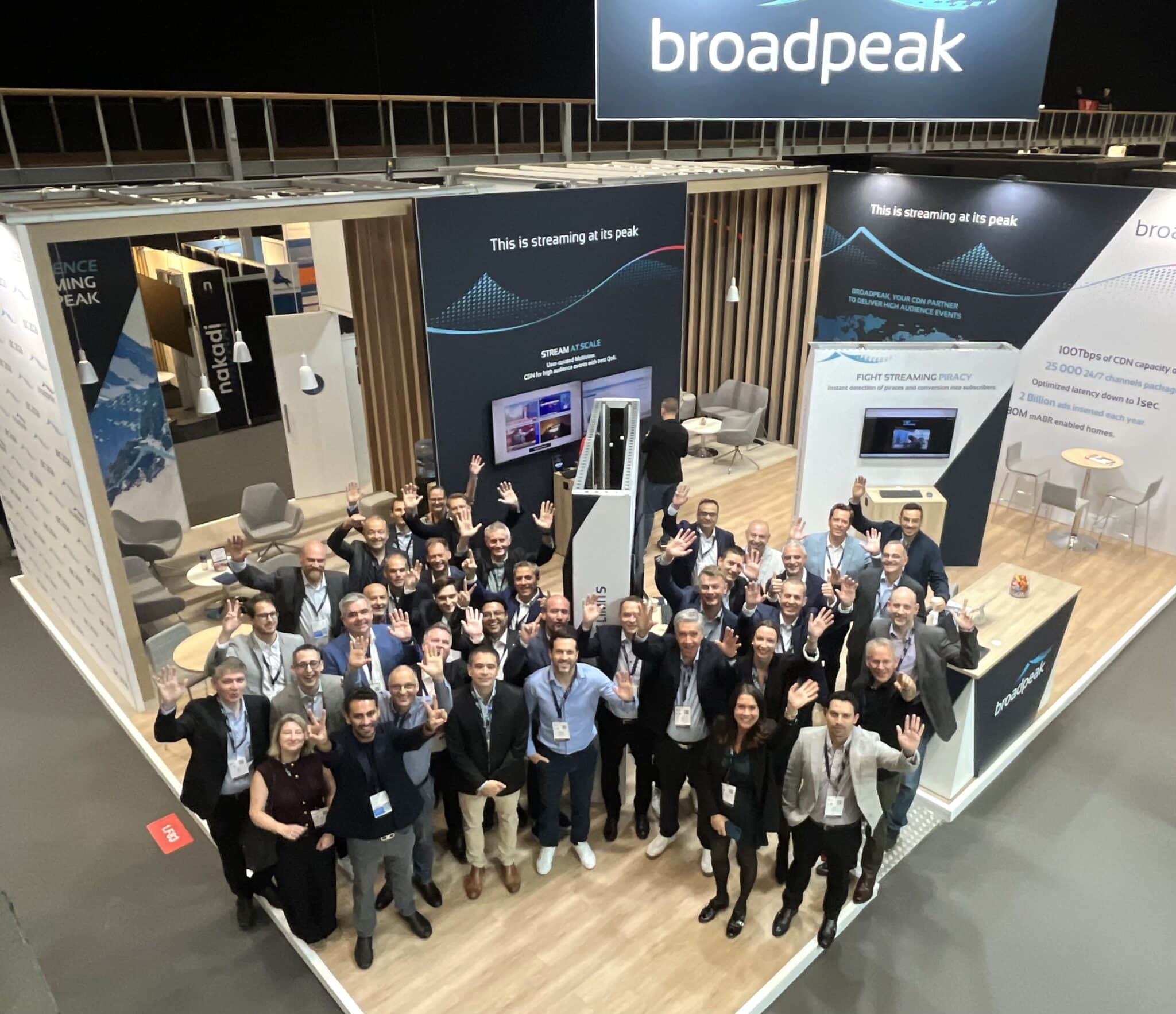
We certainly didn’t feel that 6% decrease on our booth. With 46 Broadpeakers on site and demos spanning MoQ, anti-piracy, Multiview and CTV performance advertising, the booth often felt a little too small (as usual to be frank) , for all the conversations happening around the demo pods.
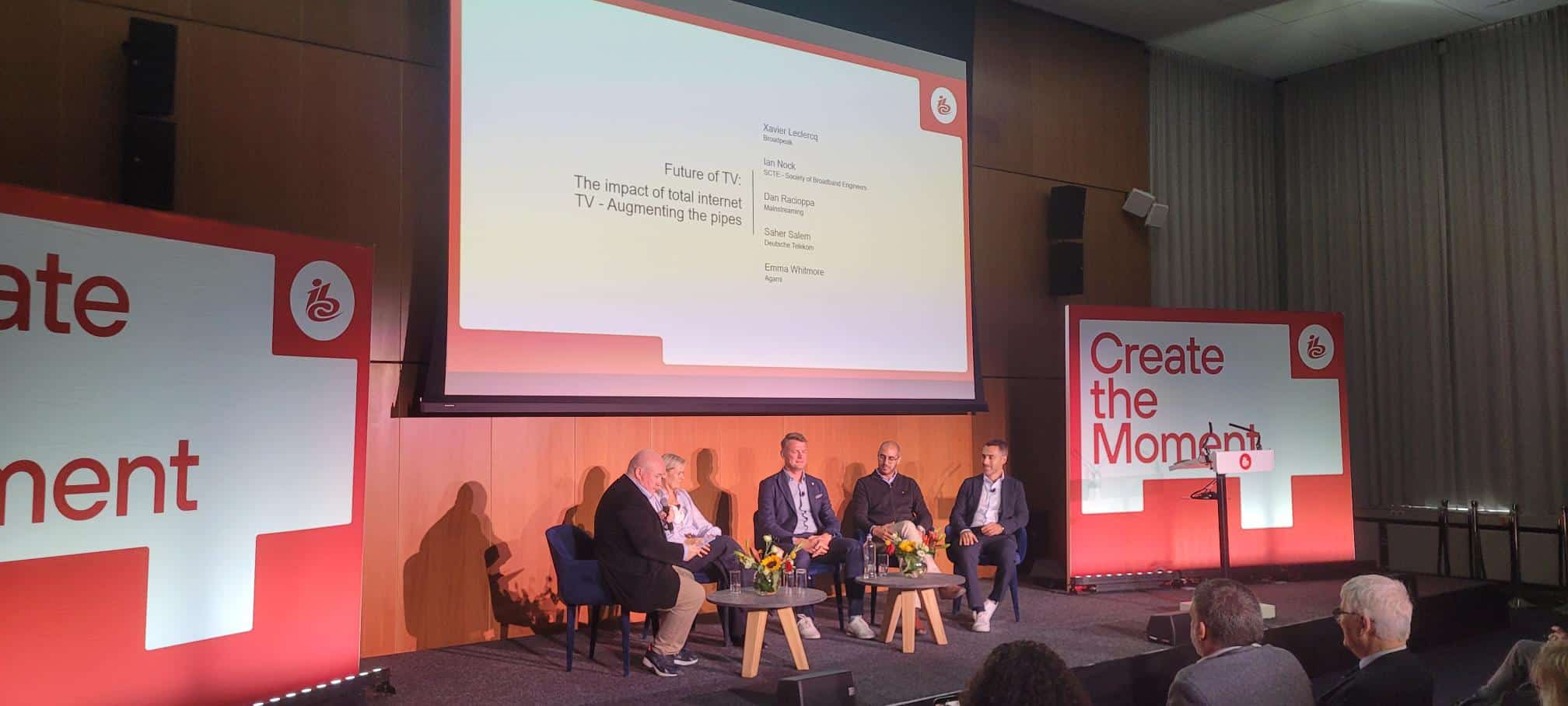
And those conversations went well beyond our booth. Xavier Leclercq (Broadpeak’s Chief Strategy & Partnerships Officer) joined SCTE’s “Future of TV – The Network Dimension” discussion, looking at what networks will need as television moves further towards internet delivery. Meanwhile, Guillaume Bichot (Broadpeak’s CTO) joined DVB sessions on both MoQ and filecasting (read more about filecasting here), continuing Broadpeak’s contribution to open standards and the industry’s transition towards IP-based media delivery.
We also came home with something extra: EdgePeak™ won the 2026 CSI Award for Best edge or video CDN deployment.
But the best part of IBC remains the conversations, with customers, partners and the many people who stopped by our booth. And after four days, some topics clearly kept coming back, both in what we heard across the show floor and in the demos that attracted the most attention.
What caught our attention at IBC 2026
1. Multiview gets personal
At IBC, Multiview was hard to miss. And for good reason: it’s one of those technologies where the benefit to the viewer is immediately obvious. More choice, more control and a richer way to follow live sports, with the potential to become a standard feature of streaming experience (it also fits well with the “Affinity Economy” discussed by Evan Shapiro at IBC.).
But behind a similar experience on screen, there are very different technical approaches. As Yann Begassat, Business Development Director at Broadpeak, said what was IBC’s highlights:
“Multiview in its various flavours, player-side, encoder-side and packager-side, was very present at the show. Broadpeak’s packager-side approach got a ton of interest, hinting at many more rollouts to come.”
And this may only be the beginning. As Olivier Karra, Cloud Solutions Director at Broadpeak pointed out, once live producers start designing content with Multiview in mind, we could see new experiences combining multiple feeds, live metadata and even social content around the event. That makes Multiview interesting on both sides of the screen: not just a new way to watch live content, but potentially a new way to create it.
At our booth and with partners including Akamai, Dotscreen, NETINT/NetActuate and Viaccess-Orca, we explored what it takes to make that potential real: processing, personalization, video quality and scalable delivery without unnecessarily multiplying bandwidth and costs. Together, the demos showed how much of the multiview experience depends on what happens behind the screen.
Watch our interview with Dotscreen for a closer look at one of the Multiview experiences we demonstrated at IBC:
2. MoQ is no longer a conversation for protocol experts only
This year, Media over QUIC (MoQ) showed maturity: the conversation is moving from lab tests towards field trials and early deployments, with a growing ecosystem working through what it will take to use MoQ in production
You could see that momentum at IBC, with panels bringing the industry together to discuss MoQ and its path towards real-world delivery, including voices from Paramount, Oracle and Cloudflare.
Broadpeak is part of that industry effort, demonstrating low-latency live sports at scale and tackling a practical question: how do we move from HTTP-based streaming to MoQ without replacing everything overnight? (Read more about the transition to MoQ HERE).
And it won’t stop at IBC. As a member of the MoQ Alliance, Broadpeak is helping build an open, interoperable ecosystem, with the conversation continuing at DEMOQED, the Alliance’s dedicated MoQ event in San Francisco on October 8.
3. The advertising conversation is changing too.
Streaming keeps growing, but one question isn’t getting any easier: how do you turn that audience into a sustainable business?
At IBC, we saw the advertising stack itself evolving: SGAI opening the door to more flexible formats, moment-based ads, and more attention shifting from serving an impression to what happens afterwards.
That last part is where we focused. At IBC, Broadpeak demonstrated BannersIn2 alongside Click2Cart the latest evolution of Click2. With Click2Cart, viewers can add an advertised product to their online shopping cart using the TV remote, without leaving what they’re watching.
Likewise, together with our partner Sofia Digital, we noticed strong interest for shoppable ads from broadcasters using HbbTV. Activating Click2 for this hybrid distribution model effectively means enabling new performance advertising revenue through existing audiences. This type of interactive ad unit format represents a new opportunity to make Linear Addressable TV more engaging.
TV has always been good at creating attention. CTV can now connect that attention to action, opening new ways to monetize streaming without simply showing more ads. Learn more about here.
4. Piracy is an audience problem, too
Anti-piracy is now more closely connected to the business of streaming. Detecting and disrupting illegal streams remains essential, but the focus now is: who is watching them?
For live events, those viewers are already showing a strong interest in the content. Real-time content replacement can disrupt the illegal stream while directing them towards legitimate access, creating a potential path from piracy to conversion into subscribers.
Not every viewer will convert, of course. But it brings anti-piracy closer to monetization and subscriber acquisition, particularly for live sports and other premium content. Learn more here.
5. Scale is getting smarter, not just bigger
Live sports keeps pushing streaming infrastructure hard. Millions of viewers can arrive at almost the same time, so having enough capacity matters, but so does where that capacity is deployed and how traffic gets to it.
At IBC, Broadpeak demonstrated several ways to address this, from HyperPoPs and CDN as a Service to Open Caching and multi-CDN delivery. Just before the show, we also added new HyperPoPs in Brazil (Learn more about it here), expanding our capacity for large streaming audiences across Latin America.
Scaling doesn’t necessarily have to mean adding more infrastructure. Higher-performing servers can handle more streaming capacity with a smaller footprint, helping operators scale while keeping infrastructure and costs under control.
6. AI is getting down to business
AI was everywhere again, but the applications are getting much more specific. Among others we saw picture enhancement, metadata generation, live sports highlights, captioning, content classification, contextual advertising, workflow orchestration,observability, and AI-powered subtitling as we demoed at our booth.
What is changing is not just the number of use cases, but how they connect. AI is starting to sit across the video workflow rather than inside isolated tools, from creating and understanding content to operating, monetizing and verifying it.
It is still maturing, but the question is increasingly practical: where can AI generate value and really keep operating costs under control?
Extra: Sovereignty is entering the infrastructure conversation
Another topic discussed in Amsterdam was sovereignty. Today, much of this discussion centers on CDN and cloud infrastructure, but it increasingly touches data, AI, security, supply chains and operational control too.
For broadcasters and operators, the question is becoming broader than where does my video run? It is also who ultimately controls the data and technology it depends on?
Sovereignty is hardly a trend the industry would have chosen. But in today’s geopolitical climate, questions around control and dependency are becoming difficult to separate from technology decisions, and unlikely to disappear anytime soon.
The lines keep blurring
We started with conversations that kept crossing from one topic into another: technology into experience, experience into monetization, and monetization into cost. That may be the real takeaway from IBC 2026: these questions can no longer be tackled separately.
The technology is increasingly there. The challenge now is turning it into sustainable growth: finding better ways to monetize streaming while keeping costs under control.
And “sustainable” matters in another sense too. We would have liked environmental impact to be a bigger part of the conversation this year.
Plenty to work on before we meet again in Amsterdam.