
If content providers see streaming as just another way to distribute TV, they risk missing the bigger opportunity: making the whole viewing experience more valuable.
Remember when Netflix released the entire first season of House of Cards in 2013? Instead of waiting a week for the next episode, viewers could watch the whole season whenever they wanted. Binge-watching helped Netflix challenge traditional TV and change viewing habits.
Streaming might have won, but the competition has now shifted. Today, Netflix is fighting for attention against TikTok, Instagram and especially YouTube, which attracts audiences with everything from short clips to long-form videos.
Viewing habits are changing again. And this time, the shift isn’t just about what we watch, but what happens around it.
Content providers risk missing the bigger picture if they treat streaming as just another distribution channel because this shift raises a more fundamental question: how can the viewing experience itself become an integral part of their strategy?
According to a recent Bloomberg report (1), several of Netflix’s biggest hits have seen significant audience declines between their first and second seasons [i]. Meanwhile, shorter formats such as microdramas are gaining attention, adding another dimension to the competition for viewers.
Recent TV hits show that audiences aren’t simply moving from traditional TV to streaming. Watching what we want, when we want, still matters, but so do the things that made traditional TV successful: weekly episodes, anticipation, live events, and shared moments. Social media and fan communities keep the conversation going, while streaming helps content reach more people. For media distributors, it’s no longer just about where and when people watch, but how all these experiences connect.
The Traitors UK: A Case Study in Shared Viewing
Few shows illustrate this better than The Traitors [ii] in the United Kingdom.
The format actually started in the Netherlands and has since been adapted in countries around the world. But something different happened in the UK . The BBC version, hosted by Claudia Winkleman, launched in late 2022 and gradually became a word-of-mouth hit. Then Series 2 arrived in January 2024, and that’s when things really took off.
The audience grew significantly (2), The Traitors became one of those shows everyone seemed to be talking about, and that momentum continued with Series 3 in 2025. Then came The Celebrity Traitors later that year, pushing the format to another level again.
The second and latest Celebrity Traitors was launched on BBC One on 1 October 2026 and already hit new records (3). It opened its new season with 8.9 million viewers, up nearly 3 million from the 6.1 million who watched last year’s premiere. The episode captured an impressive 54.9% of the total TV audience, rising from 46.4% last year. Its performance among younger viewers was even more striking: 1.6 million 16- to 34-year-olds tuned in, accounting for 83.5% of all viewers in that age group watching TV at the time.
At a time when younger generations are increasingly turning away from traditional TV, The Traitors has achieved something rare: bringing them back to the living room . This makes the show not just a ratings success, but a genuine intergenerational phenomenon, demonstrating the enduring power of television to bring audiences together.
Those figures tell an interesting story because they show the remarkably powerful shared moment that scheduled TV can still create. But today, that moment is one part of the life of a program.
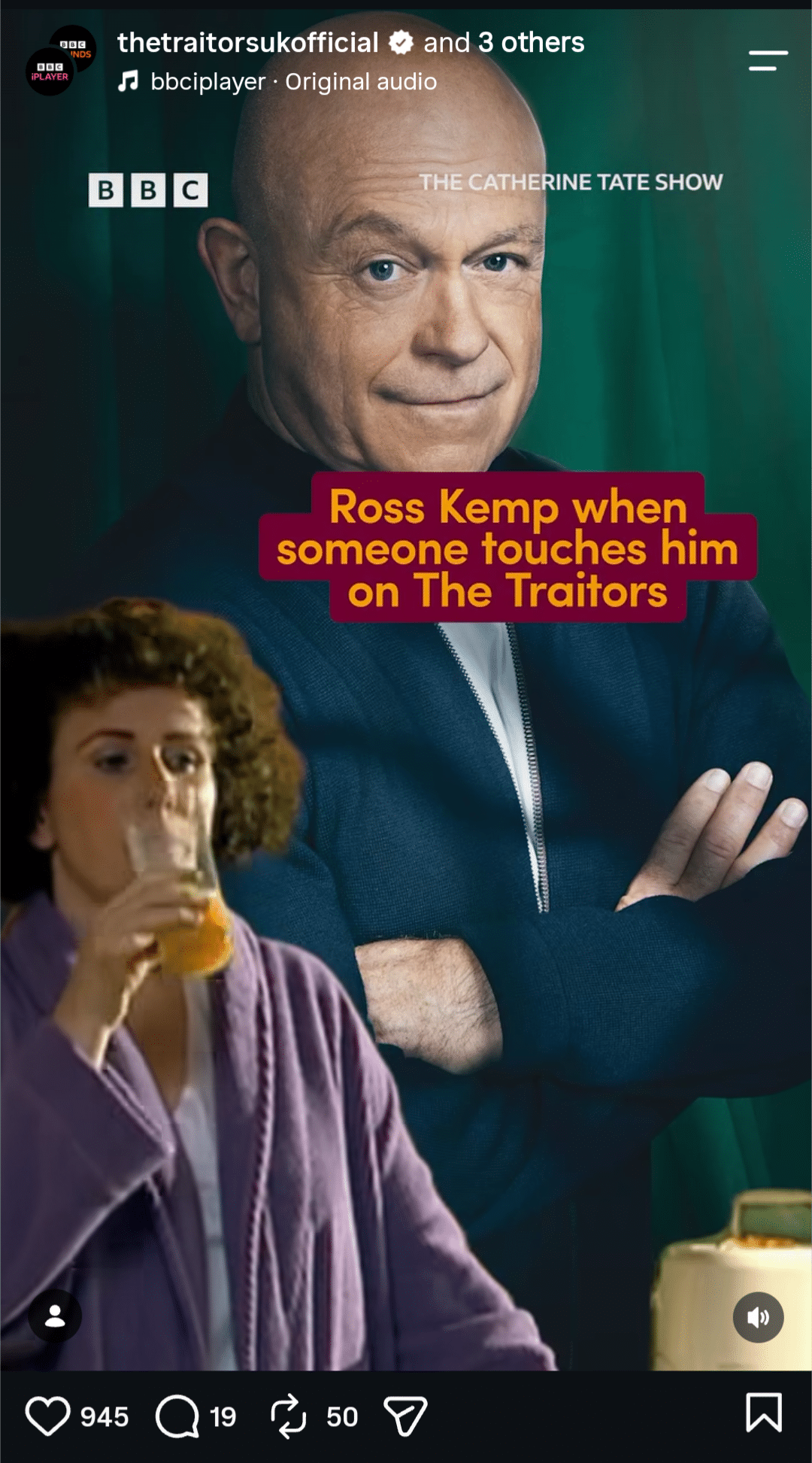
After the first two episodes aired, memes, clips and reactions quickly appeared across social media, keeping the conversation around the show going until the next episode.
For example ‘Uncloaked’ is the companion show to the UK version of The Traitors, extending the main program through interviews, behind-the-scenes discussion and reactions with contestants and guests. It gives fans another place to engage with the story and keeps the conversation going beyond the main broadcast.
A TV show doesn’t just live on TV anymore. You might watch The Traitors on BBC One or iPlayer, combine with a ‘watch along’ on YouTube, then see clips on socials, reactions from creators or a podcast about it. It’s all part of the same content ecosystem, even if we watch it in different places.
Television, streaming and online video are becoming increasingly intertwined. YouTube is increasingly watched on TV screens, broadcasters distribute content through their own streaming services and social platforms, and audience measurement is beginning to follow viewers across these environments.
Ofcom (4) found that average daily YouTube viewing on TV sets more than doubled, from nine minutes per person in 2022 to 19 minutes in 2025, while total in-home YouTube viewing reached 41 minutes a day across devices. And audience measurement is following this shift: in July 2025, Barb began reporting viewing figures for 200 YouTube channels on TV sets (5). According to Barb, TV sets accounted for 43% of in-home, Wi-Fi-based YouTube viewing among people aged 16 and over in the second quarter of 2025.
The transition isn’t simply from television to streaming. Television itself is becoming a streaming experience.
The Triangle Behind Today’s Biggest TV Hits: Event, Creators and Streaming
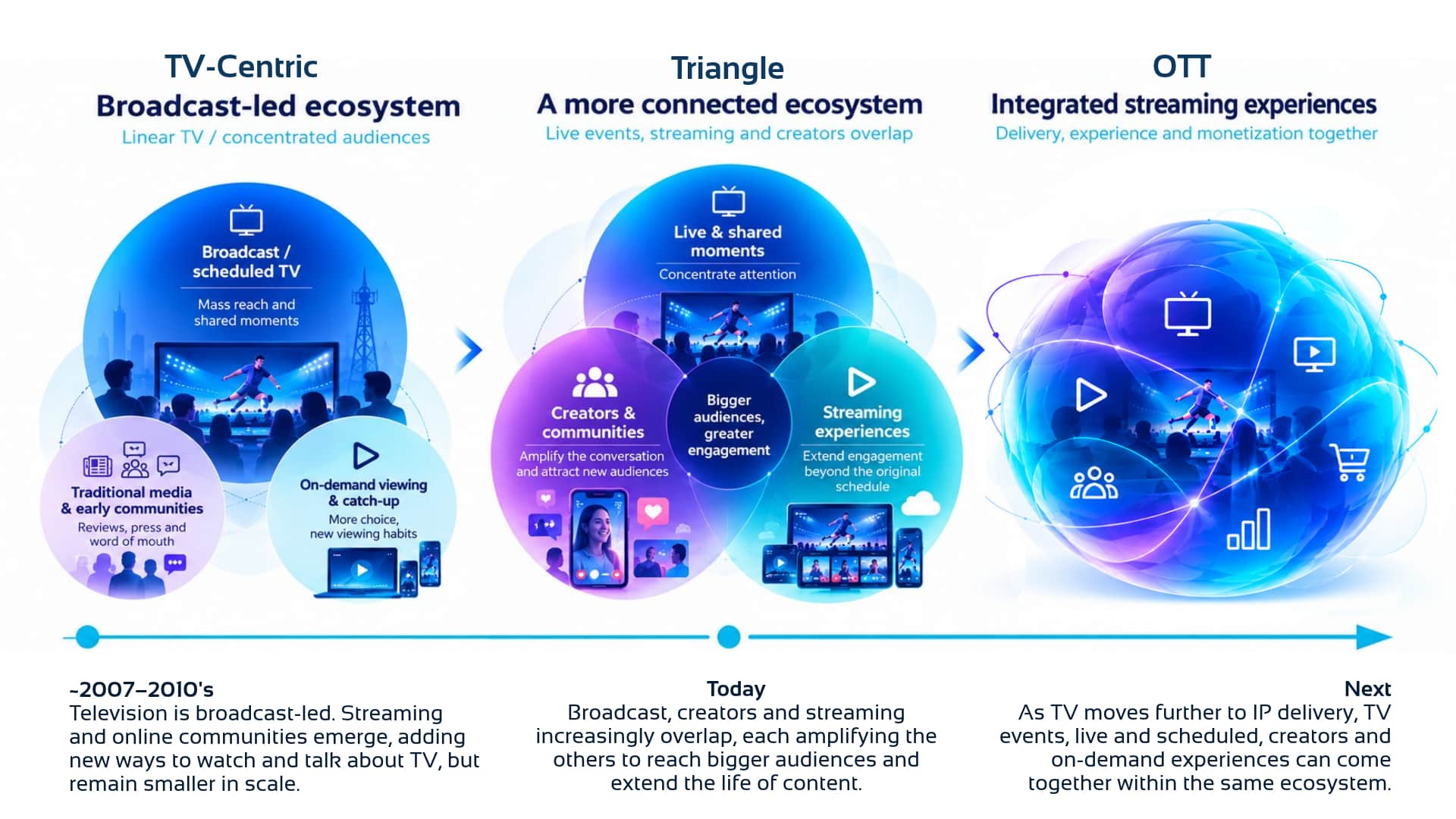
That brings us to the triangle behind today’s biggest TV hits: Televised Event, Creators & Communities, and Streaming.
Event/ scheduled TV = concentration. One of television’s historical strengths is its ability to concentrate large audiences around a shared moment, getting people watching and talking at the same time. As streaming moves further into live and scheduled programming, it is increasingly taking on this role too.
Creators & Communities = amplification. and fandom, helping shows become social phenomena and leading new audiences to discover them.
Streaming = extension. it allows content, and the experience around it, to travel beyond the original schedule, so people can keep watching after that initial moment, make other s discover and catch up.
In simple terms: Event creates the moment, creators keep the conversation moving, and streaming extends its life.
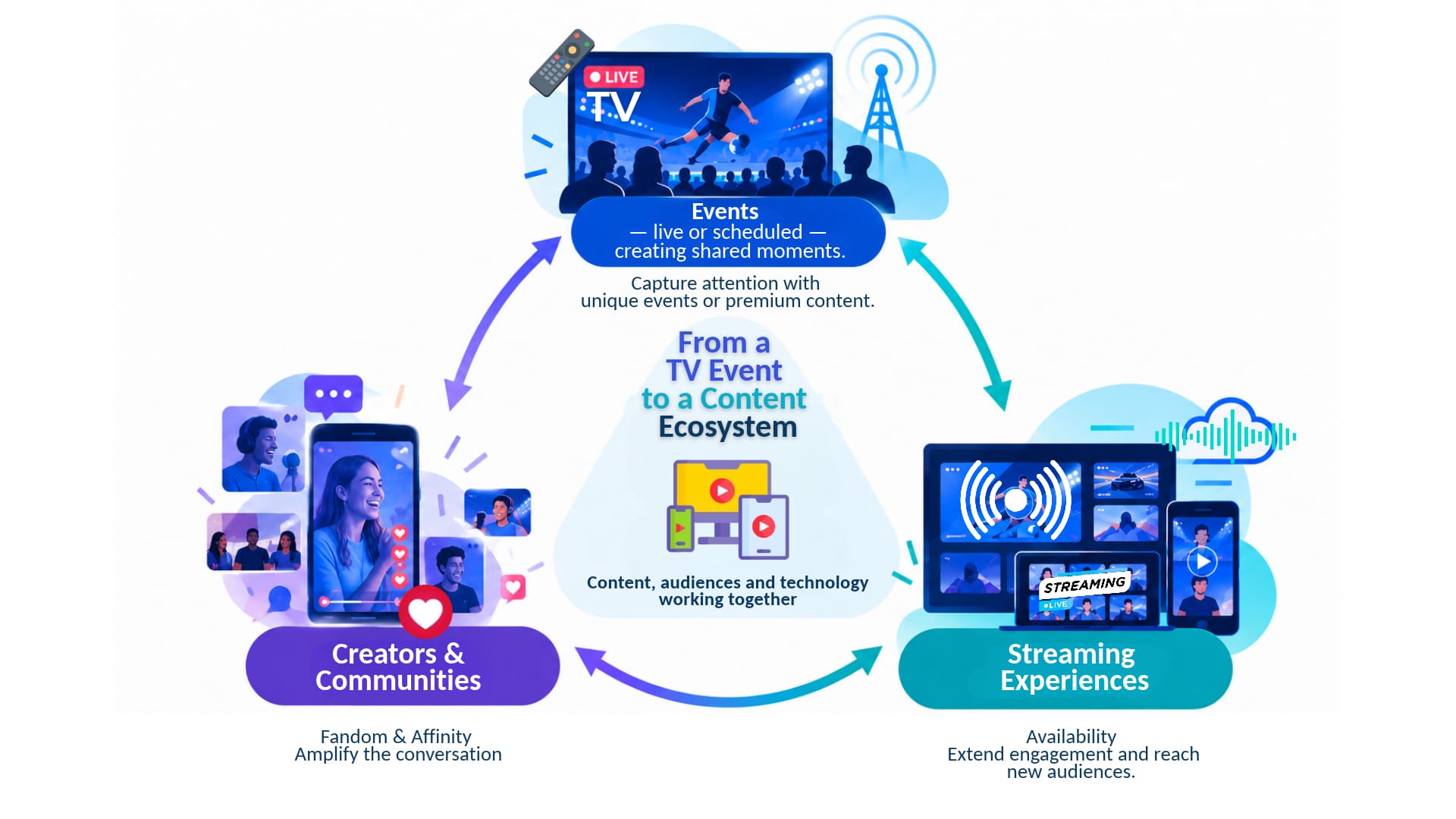
But these roles are no longer neatly apart. Streaming is moving into live and scheduled programming, creators and communities are increasingly shaping how content is discovered, and broadcasters themselves are creating their platforms. The characteristics that make television successful, creating a shared moment, amplifying it through communities and extending its reach, are increasingly coming together across an IP-delivered ecosystem.
The point isn’t that every successful program needs to follow the same formula. It’s that these experiences are becoming increasingly connected. For content providers, this changes the way streaming needs to be approached. It’s not just about making the show available. It’s about thinking through the whole experience: from the moment audiences tune in to what keeps them engaged and brings them back.
Beyond the Shared Moment
The Traitors is far from the only example. Major sporting events and competitions like Eurovision also bring millions of people together, but the experience doesn’t end when the broadcast does.
In 2026, the Eurovision Grand Final achieved a 42.6% TV viewing share (6), while official Eurovision content generated more than 2.75 billion views across YouTube, TikTok, Instagram, and Facebook throughout the season.
Brazil’s CazéTV takes this a step further (7). It ranked first worldwide for Instagram engagement among sports media outlets for four consecutive months in 2026, combining live sports streaming with match highlights, original shows, and social media content that keeps its audience engaged even when there are no games to broadcast.
It’s a good illustration of what media analyst Evan Shapiro calls the Affinity Economy (8), where traditional media and the creator economy increasingly overlap.
For content providers, the opportunity goes beyond attracting a large audience for a single event. It’s about finding ways to keep that audience engaged, create new experiences, and build a relationship that lasts beyond the live stream.
And making that happen means thinking about video delivery and the viewing experience together.
From delivering streams to building streaming experiences
All of this raises another question: what does it mean for the technology behind streaming?
As television moves to streaming, the opportunity goes well beyond delivering the same programs over a different network. It’s also a chance to rethink how content is produced, experienced, and monetized.
Take The Traitors. What if viewers could follow several contestants’ reactions during the roundtable, choosing between different camera angles with Multiview? It’s a simple example, but it raises an interesting possibility: What if streaming capabilities were considered from the production stage, rather than added once the program was finished?
A great TV moment can bring millions of people together. But making the most of that moment means thinking about the content, the viewing experience, and the technology behind it together, not as separate parts of the business.
And there’s a practical side to all this: new experiences need to be delivered reliably, at a cost that makes sense, even when millions of viewers show up at once.
For content providers, this calls for a broader approach to streaming. The question is no longer simply how to get a program onto more screens, but what kind of experience they want to create around it, how to deliver it efficiently, and how to make it sustainable.
The triangle behind today’s TV hits points to that same shift. Shared moments, communities, and streaming experiences are becoming part of a more connected ecosystem. The opportunity is to build on those connections, rather than treat each part of the viewing journey in isolation.
A great TV moment can bring millions of people together. What streaming adds is the chance to do more with that moment, before, during, and long after the show ends.
Disclaimer: The Traitors is a trademark of its respective owner. This article is an independent industry analysis. Broadpeak is not affiliated with or endorsed by the show’s producers or broadcasters of The Traitors UK.
[i] The Bloomberg report suggests viewers are increasingly giving up on Netflix shows after one season, possibly because of frequent cancellations, long waits between seasons, and content that feels made for an algorithm rather than for audiences.
[ii] The Traitors originated in the Netherlands in 2021 as De Verraders, created by Marc Pos and IDTV, with Jasper Hoogendoorn also credited. Distributed internationally by All3Media, the format has since been adapted in more than 30 countries, with versions featuring regular contestants, celebrities or both.
Sources
(1) Netflix Viewers Are Abandoning Shows After One Season – Bloomberg | © Bloomberg 2026
(2) Wink Murder on steroids: behind the scenes of The Traitors | Royal Television Society | © Royal Television Society 2023
(3) Celebrity Traitors debut draws almost 9m viewers and more than half of TV audience | The Traitors | The Guardian | © The Guardian 2026
(4) Nation’s media habits revealed in annual Ofcom report | © Ofcom 2026
(5) Barb starts reporting TV-set viewing to YouTube channels in world-first initiative Barb | © Barb 2025
(6) 70th Eurovision Song Contest huge hit with young audiences as world’s largest live music event celebrates 70 years | © Eurovision 2026
(7) CazéTV supera veículos esportivos de todo o mundo em engajamento no Instagram | © MKT Esportivo 2026
(8) Media War & Peace | Evan Shapiro | Substack | © Evan Shapiro 2026