
For 39 days, the 2026 FIFA World Cup™ brought together 48 teams across 104 matches, making it the largest tournament in the competition’s history. But from inside a streaming network, the tournament looked very different.
A single football match leaves a surprisingly precise signature in network traffic. Kick-off triggers the first surge. Halftime produces an immediate drop. Hydration breaks appear as brief pauses in consumption. If the match goes to extra time, the traffic pattern stretches with it. Even a penalty shootout leaves its own unmistakable footprint.
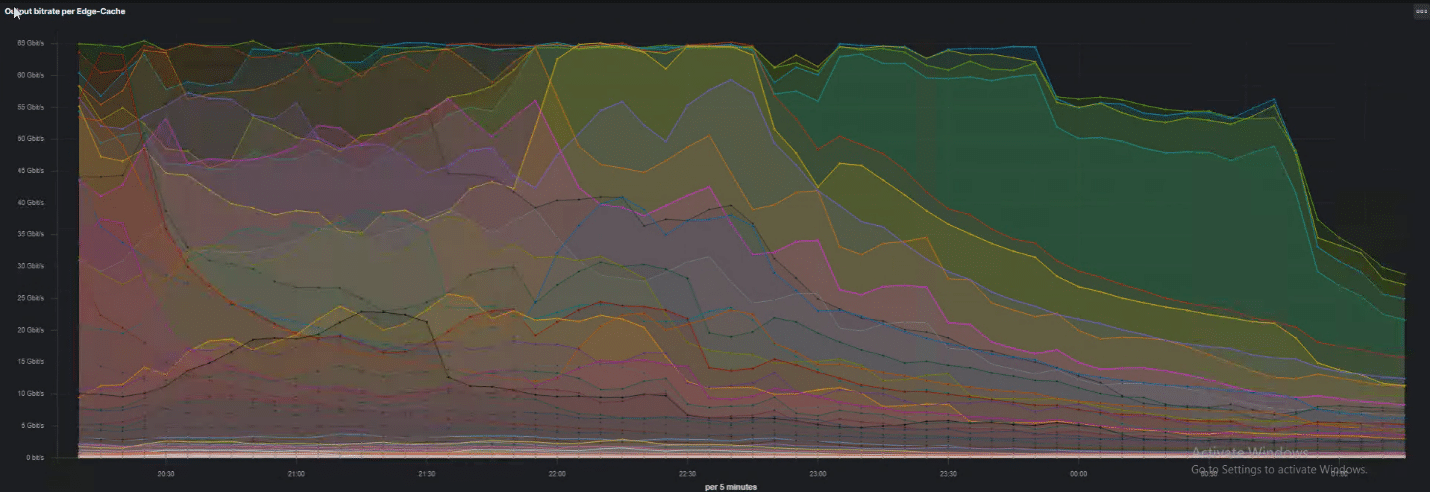
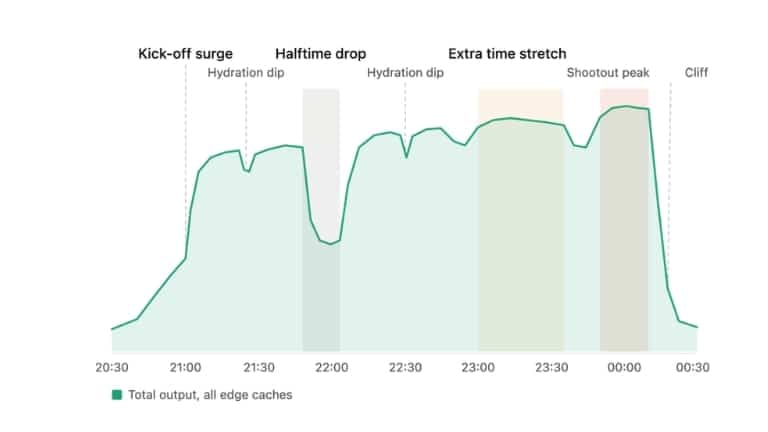
Figures 1 and 2 offer a perspective few people ever see. It reveals how millions of viewers behaved while watching the game: every rise and fall reflects collective audience actions happening in real time, creating a network-level view of the game that broadcasters never see on screen.
For video streaming providers, those patterns matter as much as audience size. They determine where traffic concentrates, how infrastructure responds to sudden demand and, ultimately, whether viewers enjoy a seamless experience or encounter buffering at the tournament’s most critical moments.
The 2026 World Cup generated countless headlines about record audiences, new streaming milestones and unprecedented digital engagement. This article adds another layer to that story, examining what those audience records looked like from inside the streaming network.

Streaming Around the World: The U.S., the UK and Brazil
The United States, the United Kingdom and Brazil offer three complementary perspectives on the evolution of live sports streaming. Together, they show how broadcasters and streaming platforms are adapting to changing audience behaviors, each reflecting a different experience in the transition toward a more streaming-centric future.
United States: Streaming Strengthens Its Role
The United States illustrated how streaming continues to strengthen its role alongside traditional television during major sporting events.
According to streaming analyst Dan Rayburn [1], the 2026 FIFA World Cup™ final averaged a reported 61.5 million viewers across FOX and NBCUniversal properties, with streaming accounting for an estimated 15% to 20% of the total audience. While Rayburn notes that changes to Nielsen’s measurement methodology make direct comparisons with Qatar 2022 difficult, the tournament nevertheless established several important streaming milestones.
Telemundo reported an Average Minute Audience of 6.1 million streaming viewers for Mexico versus South Korea, describing it as the most-streamed Spanish-language football match in US history. Tubi also attracted 1.1 million viewers for the US team’s opening match, setting another benchmark for digital distribution.
Together, these figures suggest that streaming is no longer a secondary distribution channel for major sports in the United States. It has become an integral part of how audiences consume the tournament.
United Kingdom: Streaming Delivers the Premium Experience
If the United States demonstrated streaming at scale, the United Kingdom showed how streaming is increasingly becoming the platform for premium viewing experiences.
Throughout the tournament, the BBC broadcast its World Cup coverage in HD via traditional television, while Ultra HD was available exclusively over IP through BBC iPlayer. During the competition, the BBC delivered more than 29.6 million UHD streams, while England’s semi-final against Argentina alone generated more than 2.8 million UHD streams, reaching a record 1.8 million simultaneous UHD viewers.
Those figures represent more than another audience milestone. They illustrate how streaming is no longer simply extending the broadcast experience. The tournament’s highest-quality viewing option was available exclusively through IP delivery.
For media analyst Paolo Pescatore [2], the lesson is not that streaming replaces television, but that successful broadcasters increasingly combine the editorial strengths of traditional broadcasting with the flexibility, personalization and technical innovation of streaming. As broadcasters continue to innovate, streaming is becoming the platform where many of those innovations are first introduced.
Brazil: Streaming Becomes Digital-First
Brazil offers a different perspective altogether. Rather than extending the traditional broadcast model, digital-first platforms are redefining how live sports are produced, distributed and experienced.
For the first time, CazéTV streamed all 104 FIFA World Cup™ matches free on YouTube, expanding from just 22 matches during Qatar 2022. The result was unprecedented: CazéTV now accounts for 29 of the 30 most-watched live streams in YouTube history by peak concurrent devices.
The record-breaking audiences are only part of the story. More significant is what those figures represent: tens of millions of viewers choosing to experience one of the world’s biggest sporting events through a digital-first platform designed specifically for online audiences.
As PH Santos explains [3], CazéTV has helped redefine how many Brazilians consume live sports by combining live matches with creators, influencers and constant audience interaction. As connected TVs continue to grow as a primary YouTube viewing device in Brazil, that approach generated more than 3 billion views across live broadcasts, highlights and other World Cup content.
At the same time, Globo demonstrated the continued strength of a multi-platform strategy. Across free-to-air television, pay TV and digital platforms, Globo reached 142.7 million people and generated more than 1.8 billion viewing hours, while Globoplay continued to grow compared with the previous World Cup [4].
Brazil demonstrates how audiences increasingly move across multiple platforms, with each playing a different role in the viewing experience.
Three Markets, One Direction
The three markets point to the same conclusion: streaming has become a core component of live sports distribution. What differs is how each market is using it. In the United States, streaming complements broadcast at massive scale. In the United Kingdom, it delivers premium experiences unavailable on linear television. In Brazil, digital-first platforms are redefining both the viewing experience and the relationship between audiences and live sports.
In other words, these examples from different markets reveal the same underlying trend: some viewers are choosing streaming because it complements television, others because it offers a premium experience, and others because it has become their default way to watch.
Those differences have one consequence in common. Every additional stream, every UHD session and every concurrency record translate into millions of playback requests that must be delivered reliably in real time. Public audience figures describe the scale of the event. Broadpeak’s operational data reveals how that scale behaved inside the network.
Figure 3 illustrates where these trends could lead. It is not a forecast, but a visual interpretation of the direction suggested by the United States, the United Kingdom and Brazil: streaming is steadily becoming a more central component of the live sports experience, bringing new opportunities for broadcasters and new operational demands for streaming platforms.
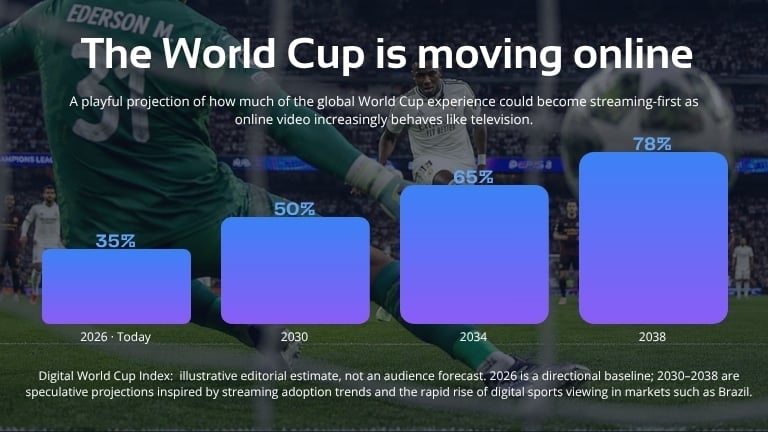
If audience figures can tell us how the tournament was watched, Broadpeak’s operational data tells the other half of the story: what those viewing habits looked like inside the streaming network, and what they mean for the future of live sports delivery.
When Millions Press Play: Broadcast-Scale Streaming in Action
The audience numbers tell one side of the story. Behind them is another question: what does it take to deliver live video when millions of viewers show up at the same time?
During the 2026 tournament, Broadpeak saw that challenge play out across customer networks around the world. At this scale, every match is a live stress test for every component of the streaming chain: origin servers, CDNs, content management systems and operational teams.
During one of the tournament’s largest matches, a Broadpeak-powered platform in Latin America reached 2.1 Tbps of peak traffic. Broadpeak estimates that delivering the same audience entirely through unicast would have required around 12.5 Tbps of capacity.
The difference was just as striking over the course of the match. Viewers consumed more than 33 PB of video, while only around 5 PB had to traverse the unicast CDN, avoiding nearly 28 PB of additional unicast traffic.
In other words, the platform delivered a massive audience using a fraction of the capacity that traditional streaming would have required. Serving the same audience through unicast delivery alone would have demanded roughly six times more network capacity, a difference with significant implications for infrastructure investment, operating costs and energy efficiency.
The same pattern appeared across multiple deployments, where mABR efficiency rates exceeded 80%. For streaming providers, that meant being able to handle exceptional audience peaks without having to provision unicast infrastructure for a level of demand that might occur only a handful of times each year.
Yet the tournament revealed another important lesson: delivering live sports at scale is no longer only a CDN challenge.
While video delivery platforms continued to handle record traffic levels, some of the most significant operational challenges emerged elsewhere in the streaming workflow.
For instance, the most demanding moments did not always occur during the match itself. In several cases, the final whistle triggered a surge of activity as hundreds of thousands of viewers simultaneously switched channels, launched highlights or moved to post-match coverage. Those synchronized actions could place more pressure on application servers, content management systems and control platforms than on video delivery infrastructure itself.
It is a useful reminder that scaling live streaming is not only about moving more bits through the network. It is also about understanding audience behavior and ensuring that every layer of the streaming workflow can scale alongside it.
That readiness was tested throughout the competition. Across the Americas, Europe and Asia-Pacific, Broadpeak teams supported customer platforms through a follow-the-sun operational model, helping operators monitor live services and investigate anomalies in real time.
“During the World Cup, Broadpeak engineers joined live operational war-room sessions alongside customer teams throughout the tournament. This allowed engineers to investigate and respond to questions in real time, helping operators quickly distinguish normal platform behavior from potential issues and maintain confidence in the quality of service delivered to viewers,” explains Laurent Phélep, EMEA Support Manager at Broadpeak, who coordinated part of the operational coverage.
As Anthony Daniel, Broadpeak’s Operations Director for the Americas, explains, the role of the teams was often to identify meaningful patterns within the normal noise of a large-scale video platform, correlate technical indicators with viewer experience, and determine whether action was required.
For viewers, it was 104 matches – for services streaming the championship, it was 39 consecutive days of peak-time streaming.
And as more live sports viewing moves online, the challenge is shifting. We already know streaming can handle millions of simultaneous viewers. The next question is how to do it efficiently, reliably and economically, without building every network around the largest traffic peak of the year.
When the next major sporting event arrives, millions of fans will once again press play, or change channels, at exactly the same moment. There will be little room for error. And as competition for viewers intensifies, quality of experience becomes more than a technical metric. It becomes part of what keeps audiences coming back.
When the next wave hits, your network gets one chance.
This article is an independent analysis of streaming trends and operational observations during the 2026 FIFA World Cup™. Broadpeak is not affiliated with, endorsed by, or sponsored by FIFA. FIFA World Cup™ is a trademark of FIFA. All trademarks are the property of their respective owners.
Third Party Content
[1] Dan Rayburn’s LinkedIn Post on FIFA World Cup 2026 Viewership | © Dan Rayburn 2026
[2] Paolo Pescatore’s LinkedIn Post on UK broadcasters battle | © Paolo Pescatore 2026
[3] GLOBO ensinou algo importante nessa Copa! | © PH Santos 2026
[4] Grupo Globo divulga balanço de audiência de seus canais na Copa do Mundo 2026 – TELA VIVA News | © Tela Viva 2026
Other sources:
BBC thrashes ITV in World Cup Final viewing figures | Advanced Television | © Advanced Television 2026
CazéTV Case Study: How a Twitch Streamer Won World Cup Rights in Brazil | © Influencer Journalism 2026
The 2026 FIFA World Cup Statistics: By the Numbers | myteamkickoff.com | © myteamkikoff 2026
Inside FIFA: Reports | © FIFA 2026
FIFA World Cup 2026 Broadcasting Deals Value (Breakdown) | © SalaryLeaks 2026
FIFA World Cup 2026™ captivates global audiences | © FIFA 2026