
The State of CDN Market
Introduction: Why CDN Infrastructure Alone Isn’t Enough
Content Delivery Networks (CDNs) have played a central role in online video distribution for over two decades. Initially built to cache and distribute static content, CDNs evolved to handle video streaming as demand grew. The rise of OTT services in the 2010s accelerated this shift, with CDNs becoming the backbone of large-scale video delivery for both on-demand and live content.
Today, the video CDN market has reached a turning point. For OTT providers, the question is no longer who has the biggest CDN, but who can deliver live video efficiently, securely, and at predictable cost.
Recent CDN deployments with Astro in Malaysia and Telenor across Norway, Sweden and Finland, combined with new CDN-level security initiatives, place Broadpeak at the forefront of streaming innovation, driving the evolution of delivery toward data-driven, efficient models.
1. CDN Market Overview: Flat Revenue, Rising Capacity Costs
In 2023, the third-party CDN services market was about USD 5 billion, based on Streaming Media Blog’s bottom-up tally that excludes China, in-house platforms, and non-delivery lines like security or storage.

This narrower definition matches what vendors report for delivery: for example, Akamai posted USD 1.542 billion in 2023 delivery revenue. Broader “CDN market” reports (which bundle security, edge/compute and other services) cite ~USD 21.36 billion for 2023 while incorporating many more service, so it’s key to state scope: CDN means delivery here.
In this article we use the open CDN concept when telco-run CDN capacity is open to third-party content providers: Open CDNs account for a smaller share of spend today, but they matter for cost and performance because they sit close to end users and give operators more control in hybrid delivery.
The video CDN market isn’t shrinking, but its metrics are shifting. Traffic demand keeps rising, yet global CDNs report fewer bits delivered as better codecs like HEVC and AV1 and smarter ABR reduce bitrate per stream.
Still, capacity needs keep increasing. Telcos and CDN providers must invest in higher network throughput (Tbps) even when revenue, often based on data volume (TB), stays flat. That creates a growing cost imbalance.
Pricing pressure continues, but it’s less aggressive than before. With fewer major players and more disciplined contracts, CDNs now prioritize profitability. Competition has moved from pure price to efficiency, service quality, and integration with edge and security capabilities.
2. Customer Profiles and Delivery Strategies
Large OTT platforms have consolidated their CDN relationships to gain better terms and tighter control. Netflix, for example, runs its own Open Connect network with servers embedded in ISPs worldwide. ByteDance has followed a similar path with its private CDN, building and operating a global delivery infrastructure optimized for its apps like TikTok.
Not all companies operate at this scale. Others are selectively adopting hybrid CDN delivery, combining CDN services from commercial CDNs and operator CDN, to balance cost, reach, and performance where it makes sense.
3. Cost, Quality, and the Limits of Streaming Performance
Streaming economics now revolve around a balance between Quality of Experience (QoE) and delivery cost. Providers measure performance using metrics such as:
- Startup time
- Rebuffering ratio
- Average bitrate
- Error rates
The trade-off between QoE and cost shapes every decision, from bitrate ladders to CDN contracts. Sometimes we talk about a triangle:
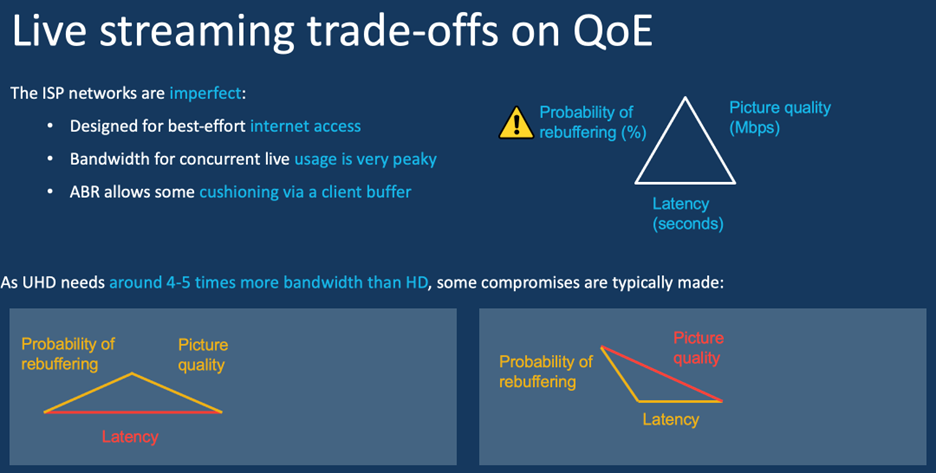
Meanwhile, 4K streaming service remains rare. Although promoted for years, actual viewer demand is limited, and bandwidth costs outweigh perceived benefits. Even for sports, HD remains the standard as the end consumers aren’t ready to pay more for the 4K quality.
Downward pricing pressure continues as global CDNs compete and cloud providers bundle delivery aggressively. This raises sustainability concerns for standalone CDN businesses and drives providers toward more flexible, service-oriented strategies.
4. Hybrid CDN Delivery Models and Emerging Technologies
Hybrid CDN delivery is now the default, mixing commercial CDNs for reach, and operator CDNs for local efficiency. Yet large live events still require careful advance planning and provisioning.
Among new technologies, multicast ABR is the only one already deployed commercially at scale. Operators such as Orange in Spain, with DAZN and Broadpeak, have proven its ability to deliver mass-audience live streams across devices while cutting backbone load. By sending a single multicast flow per channel rather than one stream per viewer, multicast ABR reduces video streaming cost while maintaining adaptive bitrate quality.
Media over QUIC (MoQ) now looks promising for reducing latency, though it’s still going through standardization and isn’t yet ready for mass deployment.
5. Security Moves to the CDN Layer
With DRM broken and streaming growing more distributed, security can’t be an afterthought: CDN-level protection is becoming a core requirement. Attacks target every part of the chain, from token-based access and manifest manipulation to large-scale DDoS and credential abuse.
Embedding security in the CDN layer reduces exposure and latency. It allows for authentication, watermarking, and traffic validation directly at the edge.
Broadpeak has integrated anti-piracy controls into its CDN architecture, helping operators and content owners protect premium live content without adding complexity or cost to the delivery workflow.
6. Broadpeak’s playbook for live
Most CDNs were built for on-demand traffic, steady, predictable, and easy to cache. Live streaming is different. Audiences arrive in seconds, peaks are sharp, and costs rise fast when traffic scales linearly.
The way forward combines multicast ABR and CDN services, delivered either through CDN companies or by Broadpeak in partnership with telcos, to handle live video at scale. Multicast ABR cuts backbone load by sending one stream per channel instead of one per viewer. CDN services provided by Broadpeak in partnership with the Telcos brings delivery closer to viewers, improving performance and cost control. This shared model, proven in production, offers a more sustainable path than earlier initiatives that failed to scale.
Broadpeak already delivers this model. With multicast ABR in live deployments, and CDN services built through operator partnerships that turn last-mile infrastructure into assets, Broadpeak helps customers rethink delivery economics while meeting audience expectations.
Conclusion: Why the Market Needs a New Playbook
The video CDN market is changing its shape. Traffic keeps growing, but success now depends less on volume and more on how efficiently and securely that traffic is delivered. The economics of streaming are shifting toward shared capacity, smarter delivery, and closer collaboration between content providers and network operators.
Hybrid architectures are welcome. Telco CDNs are key to managing cost and quality. Multicast ABR is proven for scaling live content. Security is now needed also in the CDN layer itself, protecting streams where they’re delivered.
The game is now about aligning technology, cost, and trust to make live streaming sustainable for everyone, viewers, providers, and content owners alike.
Broadpeak brings Security, CDN Services and multicast ABR together, giving you the tools to control delivery, cut costs, and guarantee live performance.
It’s time to rethink live streaming delivery. Broadpeak helps you scale, with multicast ABR and CDNaaS designed for live video.