
How Broadpeak is developing a dramatically more environmentally friendly content delivery system
April 22 is Earth Day, and this year, it also marks an important milestone for Broadpeak in its sustainability journey. We are about to complete the phase 2 of GEASCDN (Green Edge Adaptive Streaming CDN), a large-scale project supported by the France 2030 program.
GEASCDN reflects our rethinking of content delivery, designed to be more efficient and sustainable without compromising quality or scalability.
Its goal is to reduce the environmental footprint of video streaming by building a more efficient and sustainable delivery network.
1 Why is GEASCDN important? Streaming’s footprint is growing.
The shift from broadcast to streaming is accelerating, with video over IP now becoming the dominant way people access entertainment and information. But this growth comes with a problem: the current trajectory of streaming expansion is not aligned with the climate targets set by the Intergovernmental Panel on Climate Change, particularly the objective of limiting global warming to 1.5°C, or at least below 2°C. As consumption increases, so does the environmental footprint of the infrastructure required to support it.
Looking ahead, the challenge becomes even more structural. By 2030, the industry is expected to require up to four times more streaming capacity, driven by higher demand and more bandwidth-intensive formats.
Yet existing delivery models were not designed for this level of scale, especially when factoring in energy efficiency and sustainability. Streaming has become essential in everyday life, for both entertainment and access to news, which makes the question unavoidable: how can the industry continue to grow without amplifying its environmental and economic costs?
A Three-Dimensional Challenge
Scaling video streaming is a challenge across three interdependent dimensions: economical, technological, and environmental.
Economically, growth usually drives continuous infrastructure investment, with capacity often provisioned for peak demand rather than average usage, putting pressure on margins.
Technologically, live streaming remains a weak point: traffic peaks generate simultaneous demand that traditional unicast delivery model struggles to handle, leading to congestion and degraded quality of experience.
Environmentally, scaling still relies on more servers and more data transport, increasing deployed equipment and energy consumption in systems not originally designed for energy efficiency.
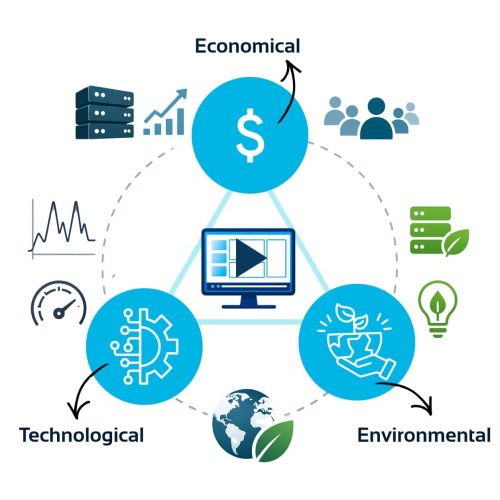
These constraints are linked. Optimizing one in isolation tends to shift the problem elsewhere.
2 Introducing GEASCDN: a different approach to CDN
Positioned as a CDN-as-a-Service model, GEASCDN shifts the focus from brute-force infrastructure expansion to smarter, distributed delivery. By optimizing resources at the edge, leveraging cutting-edge technology and reducing the physical distance between content and viewers, it fundamentally improves efficiency while lowering both operational costs and environmental impact.
At its core, GEASCDN combines several high-impact technologies.
The broadpeak’s CDN infrastructure with points of presence scattered around the word always rightly connected at the edge with the telecom operator’s network based on the Ultra high-performance streaming servers deliver up to 1 Tbps per unit with strong energy efficiency, while edge caching decentralizes traffic and eases pressure on core networks.
The telecom operators delivery infrastructure (Broadpeak powered) for those ready to partner with Broadpeak, opening their Multicast ABR and/or HPC based CDN infrastructure already used for their own needs.
The integration of multicast ABR is another key differentiator: it enables large-scale live streaming without traffic spikes, significantly reducing bandwidth consumption and limiting the need for constant infrastructure upgrades. The result is a delivery model built to handle scale more intelligently, not just more heavily.
Equally important is the ecosystem approach behind it. By partnering with ISPs, GEASCDN mutualizes infrastructure, reducing redundant deployments and opening new revenue opportunities for network operators.
This is wrapped in a SaaS platform that keeps deployment and operations simple, aligning with how customers already consume CDN services. The combination creates a more sustainable and economically viable path for streaming growth without forcing a complete reset of existing workflows.
A Three-Dimensional Approach to the Solution
GEASCDN addresses these challenges through a combination of streaming technologies, delivery architecture, and business model.
Economically, the model avoids the need for constant infrastructure expansion. Delivered as a SaaS offering, it follows the same consumption model as traditional CDNs, so content providers can adopt it without changing how they buy or operate delivery services. At the same time, revenue-sharing mechanisms create incentives for ISPs, helping rebalance the cost structure across the ecosystem.
Technologically, it combines high-performance, energy-efficient servers (up to 1 Tbps per node) with multicast ABR. This replaces duplicated unicast streams with a single shared stream for large audiences, reducing bandwidth consumption and handling traffic peaks more efficiently while maintaining consistent quality of experience.
Environmentally, the approach focuses on reducing both infrastructure footprint and data transport. By partnering with ISPs to leverage operator-side caches via APIs and localize delivery, it limits the need for additional hardware and reduces traffic across core networks. Combined with more efficient traffic distribution, this leads to lower energy consumption overall.
3 Scaling Smarter: What GEASCDN Changes for Streaming
By drastically reducing overall traffic, especially during live peaks, GEASCDN enables a more efficient use of existing networks. For streaming platforms, this translates into better profitability, as growth no longer requires proportional increases in capacity.
At the same time, end-users benefit from a more stable experience, with improved quality of experience and fewer interruptions during high-demand moments.
Based on current estimates, a French operator consuming around 1 TWh per year could avoid up to 500,000 tons of CO₂ emissions while cutting approximately 75 GWh of energy use. These are not marginal gains, they point to a structural shift in how streaming infrastructure can operate more efficiently and dramatically reduce its carbon footprint.
Finally, GEASCDN introduces a European-based alternative for content delivery, aligned with increasing regulatory and sovereignty requirements. As operators and platforms face stricter environmental targets and data governance constraints, having a solution built within this framework becomes a strategic advantage.
Beyond performance, operators now have to consider where infrastructure sits, how it’s deployed, and how it aligns with evolving regulatory and sustainability requirements.
4 Why It Matters for Broadpeak
GEASCDN is fully aligned with Broadpeak’s core purpose: designing streaming solutions that are sustainable for all. Reducing the environmental impact of video delivery is not a side initiative, it is part of the company’s broader strategy , with a clear focus on lowering the energy consumption and hardware required to deliver video content at scale.
We see GEASCDN as a direction for the industry, particularly as live streaming continues to grow and put pressure on infrastructure. The ambition is to go further than incremental improvements and establish a new model for delivery, one that can become a reference point globally for sustainable video.
5 Recognized and Supported at the National Level
GEASCDN has been recognized and supported at the highest level. Selected as a winner of the 2024–2025 French “Concours d’Innovation” (i-Nov), the project is part of the France 2030 program.
This distinction reflects the project’s combined value across innovation, economic impact, and environmental performance, key criteria in the selection process.
Backed by institutions such as Bpifrance and ADEME, GEASCDN benefits from both financial support and strategic guidance. This recognition reinforces the relevance of Broadpeak’s approach and positions the project within a broader national effort to drive sustainable innovation in digital infrastructure with global impact.
Conclusion
With GEASCDN, Broadpeak is working toward more sustainable video delivery. The project reflects a shift toward a model where streaming remains both economically viable and environmentally responsible, without compromising performance nor the user experience.
It’s still a work in progress, with completion expected in 2027. But the path is set: finding more efficient ways to scale streaming over the long term while limiting the impact of the Earth.