
Broadpeak in 2025 – Wrap Up
Streaming in 2025 pushed video services providers to focus on CDN performance, edge delivery, and monetization tools that move the needle. You could see the same pattern in every conversation: less noise, more pressure on results. Broadpeak anticipated that shift by keeping the work practical and focused on what you can deploy easily today and rely on for tomorrow.
Fifteen years in: a clear direction
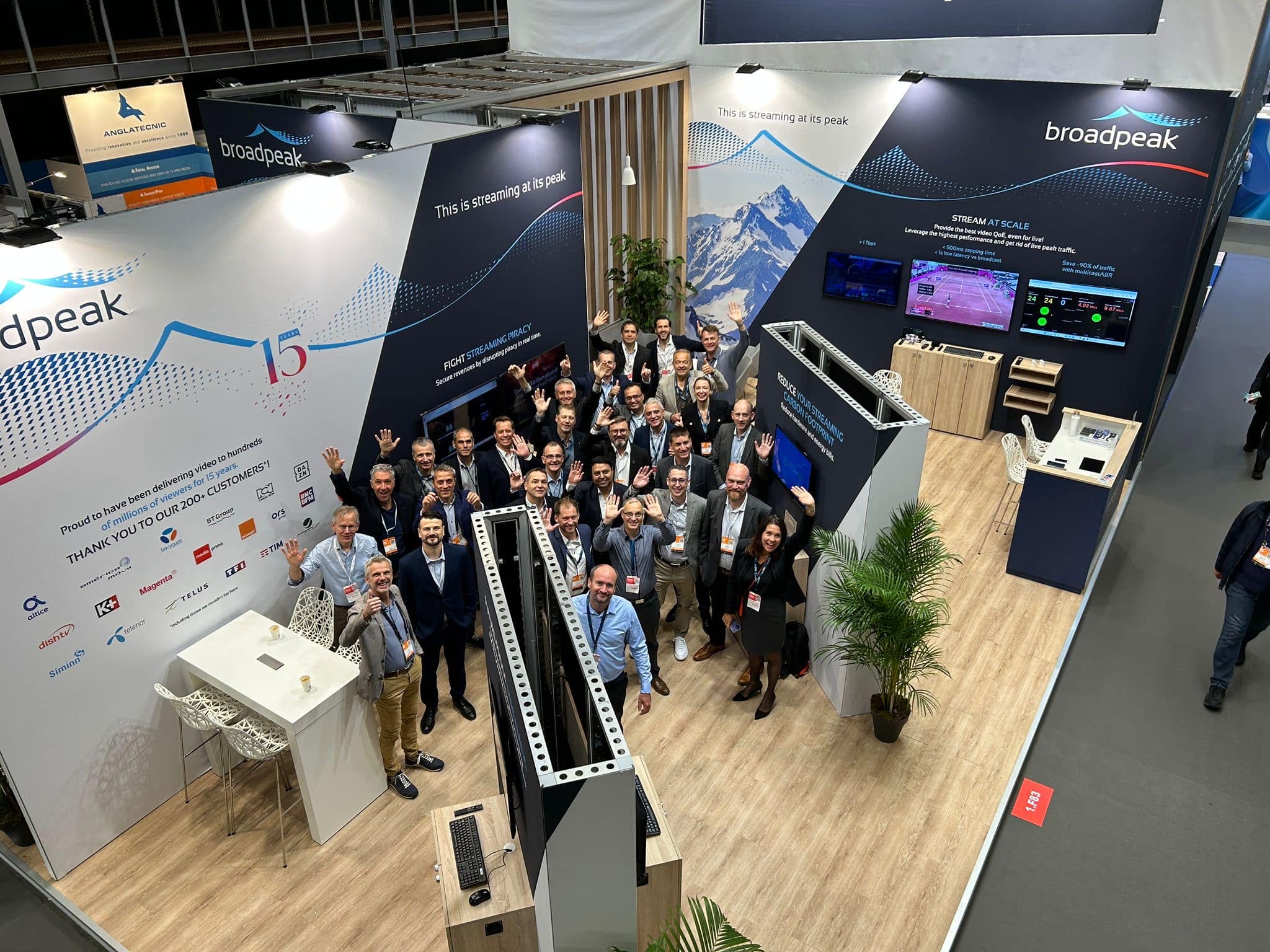
Broadpeak’s 15-year milestone highlighted how consistent engineering and product work shaped the company’s role in streaming. The updates, customer projects, and event announcements across 2025 reflected the same direction that started in 2010: build technology that solves real delivery problems, scales reliably, and adapts as streaming evolves.
This year reinforced that approach, from advances in live streaming scale to new advertising and anti-piracy capabilities, showing how the company continues to evolve while staying focused on performance, efficiency, and long-term value. Read more about our 15 years HERE.
Events shaped by practical needs: CES, NAB and IBC.
Across important events like CES, NAB show, and IBC, the conversations stayed consistent: video service providers asked for tools that fit into existing workflows and deliver measurable results. At CES, Click2® stood out because it adds interactivity to broadcast ads without major integration work.
At NAB show, discussions focused on delivery costs and peak-traffic resilience, where EdgePeak™ drew interest as a lighter path to handle load concentration at the edge with high-performance streaming capabilities.
By IBC, the priorities were clear, predictable performance, micro-burst handling, and cleaner on-prem/cloud mixes.
This shaped the demand for EdgePeak™, Adaptive Streaming CDNaaS strengthened by HyperPoPs, advanced advertising solutions and sustainability-focused delivery practices highlighted throughout the year.
Scaling live events: pressure is rising
Large live events pushed CDN edges hard in 2025, and the pressure will only increase in 2026 with major moments ahead, including the FIFA World Cup, the Super Bowl, and the Winter Olympic Games.
Video service providers shared more audits, failure reports, and internal pressure to avoid last-minute issues. Broadpeak’s response focused on practical improvements: more deterministic edge behavior during peaks, faster detection and reaction during spikes, stronger anti-piracy controls, and clearer analytics.
The launch of EdgePeak™ earlier in the year supported that shift by giving teams a high-performance caching and edge engine built to handle 1+ Tbps, reduce hardware load, cut power use, and counter real-time threats directly inside the cache.
This work went further with the HyperPoP expansion in September. New high-capacity caches in England, Switzerland, Greece, and Mexico boosted Broadpeak’s CDN as a Service with local ISP-hosted infrastructure capable of absorbing massive traffic surges during major sports and primetime events.
Built on EdgePeak™, the HyperPoPs have been delivering ultra-low latency, higher resilience, and better energy performance while supporting ad insertion, personalization, analytics, multi-CDN strategies, and multicast ABR. These advancements reflected the same direction: prioritize what video service providers can deploy now, predictable performance at scale, lower operational load, and security built for live traffic
Security and anti-piracy: now a requirement
Security stopped being an optional layer in 2025. The year marked a shift from general-purpose CDN protections to streaming-specific defenses built for high-scale events. In August, we launched our CDN security and anti-piracy solution, designed to protect premium content during peak live traffic. The system combines token validation, anti–token sharing, and scalable DDoS protection with video-level intelligence that generic CDNs or local in-house tools can’t provide. It targets revenue loss that continues to rise across the industry, with piracy expected to cost US content providers more than $113 billion by 2027.
The solution integrates directly with Broadpeak’s CDN, scaling during large sports or entertainment events and blocking credential sharing, scraping, and unauthorized access before they impact operations. It’s available on-prem or via CDNaaS and can be delivered as a managed service with 24/7 support.
Partnerships, including the joint work with NAGRAVISION, extend protection further by detecting and disrupting pirate streams in real time. This reflects a broader reality video services providers acknowledged throughout the year: delivery, visibility, and protection now work as one system, and securing high-scale streaming requires tools built specifically for video.
Sustainability has become practical engineering
Sustainability gained concrete work in 2025. We published our carbon-reduction plan and committed to cutting emissions by 31% by 2030, based on detailed assessments of our 2022–2023 footprint. Most emissions sit in scope 3, so the plan focuses on product optimization, better digital and cloud usage, supplier engagement, reduced travel, energy savings, and internal awareness. Work on scopes 1 and 2 is now moving through SBTi validation, and progress will be measured yearly.
This shift also showed up across engineering and industry collaboration. Broadpeak joined the Media Climate Accord, aiming for a 40% reduction in energy consumed per hour of streaming by 2030 and net zero by 2040. We continued contributing to better broadcast by design and technical alliances where practical efficiency matters. This also means improving cache placement, reducing energy load during peaks, and removing unnecessary steps in delivery chains.

Customer adoption patterns in 2025
Astro remained a strong example of how video service providers simplify mixed infrastructures. They combined on-prem, cloud, and existing systems without rebuilding their stack, focusing on predictable performance and clean operations. That approach matched what many operators looked for this year: stable delivery paths over abstract buzzwords.
Several large deployments reinforced the same trend. Telenor selected Broadpeak to replace its multi-country CDN architecture across Norway, Sweden, and Finland, unifying streaming for millions of users on a single high-performance platform. TELUS adopted Broadpeak’s origin packager to reduce VOD infrastructure costs and streamline operations.
On the monetization side, RMC-BFM, Chunghwa Telecom, Media Prima, and Rotana Media Services and many others used Broadpeak’s SSAI to upgrade ad workflows, scale revenues, and introduce features like clean back-to-live, advanced ad formats, and real-time targeting across live sports, news, and entertainment. Each deployment used the SaaS model to scale quickly across devices and partner platforms.
Adoption in Asia also expanded with i-CABLE launching a FAST channel using Broadpeak’s server-side ad insertion and virtual channel technology to boost its HOY app with data-driven ad strategies. These projects showed video service providers want reliable video delivery technology with tools that improve monetization without adding operational complexity.
broadpeak.io and ad-engagement tools gained traction
The customer projects announced across 2025 showed a clear shift toward monetization tools that fit inside existing operations. That momentum was carried through broadpeak.io, Broadpeak’s SaaS Platform, where video services providers expanded SSAI usage without complex migrations. broadpeak.io introduced cleaner workflows, better ad conditioning, and faster onboarding for large event coverage, FAST channels and CTV use cases.
New features also pushed ad formats forward. The partnership with Intel introduced Agentic L-Banner Advertising, combining broadpeak.io with Intel’s AI-based Data Curation Framework to automate scene-level targeting and generate L-Banner creatives directly from a product URL. This work made banner placement more relevant and reduced operational load for publishers. It also aligned with ongoing broadpeak.io support for non-linear formats through SIMID, giving operators a practical way to grow revenue without interrupting viewing.
The ecosystem widened too. Broadpeak, Skyline, and Mllabs brought SSAI into DataMiner, letting MediaOps and NetOps teams provision and monitor monetization inside the environment they already use. The collaboration with Media Press added AI-driven detection of ad breaks on streams without SCTE-35 markers, unlocking addressable TV opportunities across long-tail channels. Together, these additions showed how broadpeak.io evolved into a flexible monetization layer that supports both advanced formats and day-to-day operations with minimal disruption.
broadpeak.io wins Gold for Cloud Streaming at the 2025 Digital Media Awards
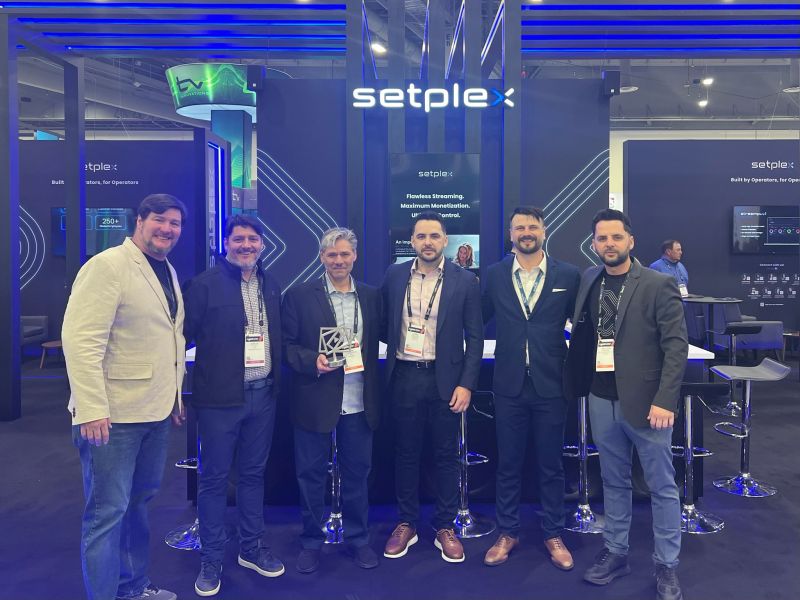
broadpeak.io received Gold in the Cloud category at the 2025 Digital Media Awards for the Adaptive Streaming CDN. The award reinforces our cloud strategy and recognises a cloud-first platform designed for real streaming workloads, including large-scale distribution and peak traffic handling.

A steady road ahead
The direction across 2025 was consistent: build streaming infrastructure that performs under pressure, keeps costs predictable, and supports real monetization.
Fifteen years in, Broadpeak’s identity is clear. We operate as an engineering-driven partner focused on scalable delivery and practical monetization, available on-prem, through your own edge strategy with EdgePeak™, or as a fully managed service with broadpeak.io.